If you’re reading it for the third time,
this page is for you.
You noticed something but you can’t prove it. Upload your conversation — we’ll count all of it, read it and tell you what’s there.
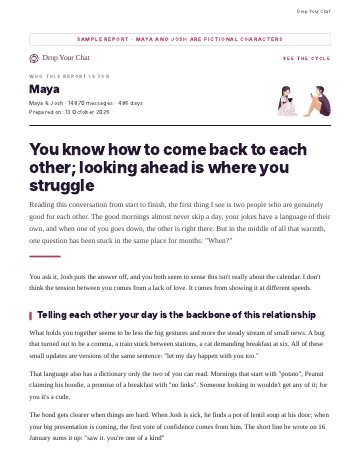 Sample report · a fictional couple
You know how to come back to each other; looking ahead is where you struggle
Reading this conversation from start to finish, the first thing I see is two people who are genuinely good for each other. The good mornings almost never skip a day, your jokes have a language of their own, and when one of you goes down, the other is right there. But in the middle of all that warmth, one question has been stuck in the same place for months: “When?”
Read the rest of the sample report (PDF) →
Sample report · a fictional couple
You know how to come back to each other; looking ahead is where you struggle
Reading this conversation from start to finish, the first thing I see is two people who are genuinely good for each other. The good mornings almost never skip a day, your jokes have a language of their own, and when one of you goes down, the other is right there. But in the middle of all that warmth, one question has been stuck in the same place for months: “When?”
Read the rest of the sample report (PDF) →
Don’t trim the conversation — upload all of it. Finding the parts that matter is our job. A repeat only shows up over time.
Up to 20 MB · 150,000 messages · .txt only · one-to-one chats only
Not sure how to export?
- Export the conversation as text in your messaging app.
- Choose without media — we only need the words.
- Drop the resulting .txt file here.
This is what the file we need looks like:
12.03.2026 21:14 - Alex: are we still meeting tomorrow?
12.03.2026 21:16 - Sam: yeah, what time works?
Note: we can only read one-to-one conversations — group chats aren't supported yet.
“Am I overthinking this?”
A message came late and you read the gap. The tone shifted, and you caught it. Then you asked yourself the usual question: am I making this up?
It’s hard to explain to anyone, because saying it out loud shrinks it. “They replied late” sounds ridiculous next to what you actually felt.
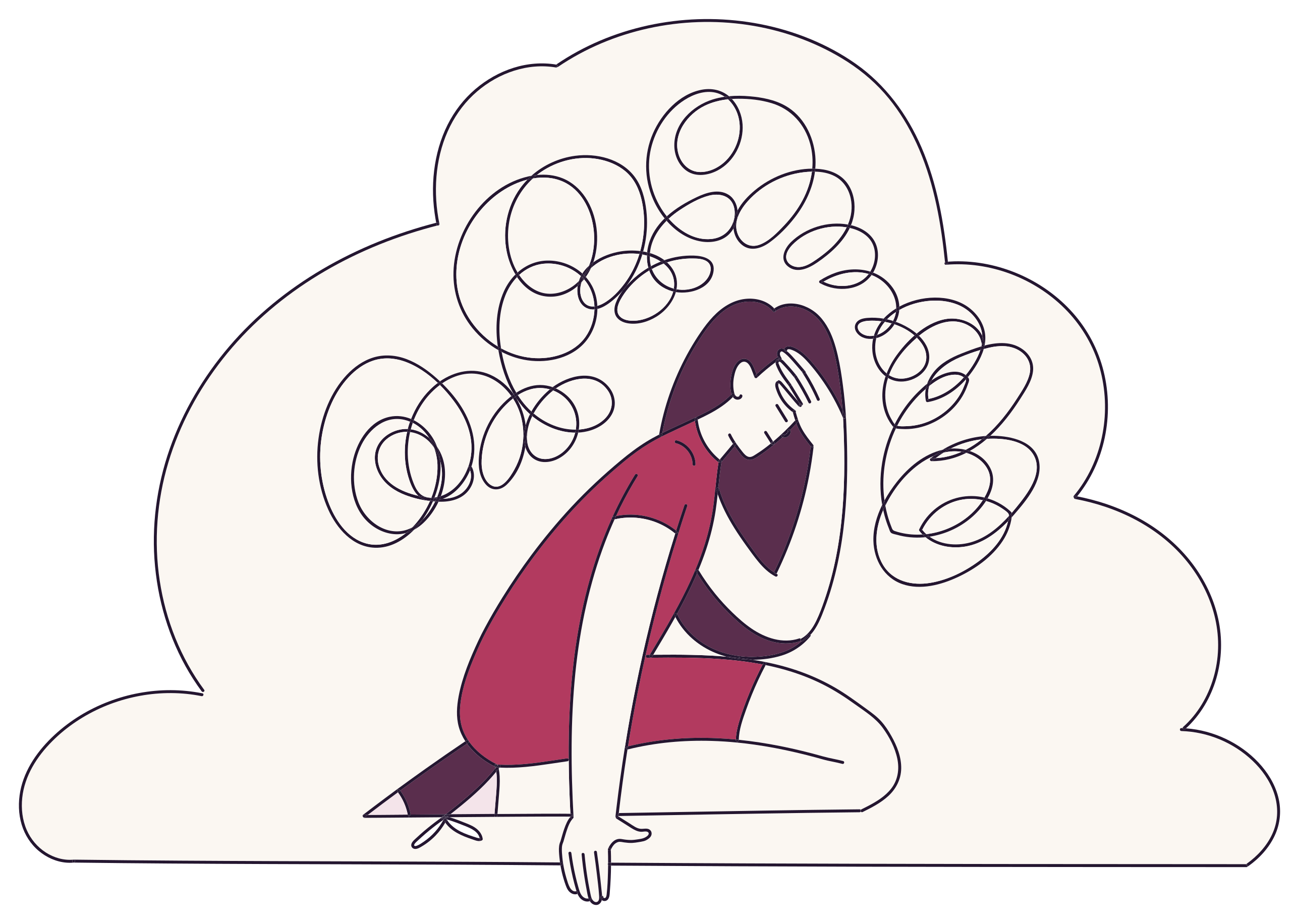
Maybe you are overthinking.
Maybe your read was right and nobody ever confirmed it.
Both are possible — and both are written into the conversation.
We read it the way you can’t: by counting. And we tell you what came out, without dressing it up.
Three steps, a few minutes.
You upload the chat. No account to make.
We count every message and read closely — in long chats, an excerpt spread across the whole period. Who moves closer, who pulls back, which subject keeps returning, what happens after a rupture.
You get a report that tells your story. Not a dashboard, not a score — something to read.
Does the same disagreement keep coming back?
Some arguments don’t happen just once. The subject changes; the order doesn’t:
From inside, each one feels new. From outside, it’s the sixth run of the same argument — and we can count them. We won’t tell you who was right; that was never the point.
Don’t read this asking “is it me, or is it them?”
There are better questions — and your conversation can answer them:

Who do I become around them?
Who do they become around me?
And what has formed between us?
Every relationship — a partner, an ex, someone you’re seeing, your closest friend — has two people in it. But there’s a third thing: what has built up between you over time. That’s what we read.
This is not a therapy app.
- We don’t diagnose.
- We won’t call anyone “narcissist”, “avoidant” or “toxic”.
- We don’t give you a score like “82% compatible”.
- We don’t claim to know what the other person is thinking.
- We don’t decide what you should do. The few small suggestions in the report come only from this conversation.
Behind it: When we read your conversation we borrow questions from a few ways of looking at relationships: Gottman, transactional analysis and Jung. None of those names appear in your report. The report doesn’t explain theory; it tells you what happens in your conversation.
Four questions every report has to answer.
The chapter titles come from your conversation, so they’re different every time. But these four questions get answered in every report — and if the conversation holds no trace of an answer, we say so plainly:
Where your chat goes, and when it’s deleted.

- We do the counting in your browser. The part to be read goes to our server, where it’s kept encrypted and deleted once the report is ready — within an hour at the latest.
- We don’t read your chat. OpenAI’s model reads it and writes the report; OpenAI doesn’t use this data to train its models.
- The report comes only to you; it’s kept encrypted for 72 hours, then deleted.
- We don’t ask you to sign up.
There are two people in that chat and the second one isn’t here. So the report never passes judgement on them — it only describes what happens between you.